Archive for the ‘Uncategorized’ Category
Kelly died today.
She was, near as we could tell, around 13.
The official diagnosis was a splenetic tumor.
Toward the end she could barely stand up…and even lay down. I had to help her down the stairs and carry her back up…and she wasn’t a little dog.
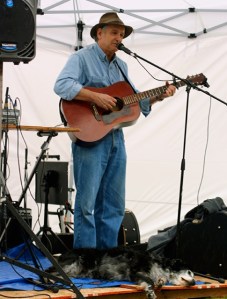
Kelly was with me at my mos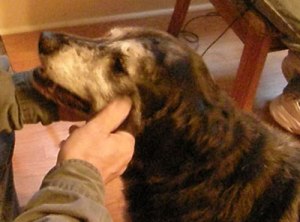 t recent performance…a Songwriters in Seattle showcase at the Couth Buzzard. When I took my place to sing, she struggled to her feet from the table where we had been sitting and joined me. She lay down at my feet and heard, once again, how she had, shortly after we selected her from the pound, inspired me to write and perform songs again. My first new song was, appropriately, “Life Goes Better With a Dog!”
She sat patiently through the entire set, waiting for the finale…the second song I wrote for her, “She’s a Good Ol’ Dog.” It chronicled her aging and deteriorating condition.
“I see her getting older
There’s things she just can’t do
She takes the stairs now one-by-one
Instead of two by two…”
She was an adult dog when we got her. My daughter found her sharing a cell in the back of the pound with a fellow inmate. We took her to the play area and put her through her paces. She aced the audition…fetching…coming…sitting…etc…most of which she conveniently forgot how to do after we took her home.
She had a variety of health issues including chronic yeast growths in her ears and privates. I regularly had to flush the ears and apply ointment to all infected areas. Her baths required medicated shampoo, which had to remain on her at least 10 minutes before rinsing. It was the time she would invariably exact her revenge for the indignity by shaking off the soap and water all in my direction. Her favorite part came after the rinsing and another vigorous shaking…when I would swaddle her in the towels and vainly attempt to dry her. That took the better half of the day and lots of sunshine…in Seattle!
In addition to the family, Kelly had Murphy, my wife’s little fluffy white fellow-pound refugee. Murphy was much younger and, being a little fluffy thing, more energetic. He compelled Kelly to play…he kept her young…until she was suddenly old. This morning, as the time for the vet appointment was passing, Murphy did not eat. Not even a piece of apple. He can hear an apple being sliced in the next county and be underfoot begging quicker’n you can say “Yo, Rinny!” Not today.
So, today, we took Kelly to a new vet, for a second opinion. After his examination he basically confirmed the original diagnosis. The splenetic tumor, with internal bleeding. Our choice was to take her home…and watch her get progressively worse…with painful complications, or let her go. We were with her until the end. The vet sedated her before administering the final injection. So, she really did just go to sleep. She was at peace.
The tears are flowing even as I write this.
I miss my dog

“She’s a good ol’ dog
She’s a good ol’ dog
When she’s with me I never feel alone
She’s a good ol’ dog
She’s a good ol’ dog
Best damn friend I think I’ve ever known.
She’s a good ol’ dog…”
http://www.youtube.com/watch?v=7OTBol2IyW4&feature=youtu.be
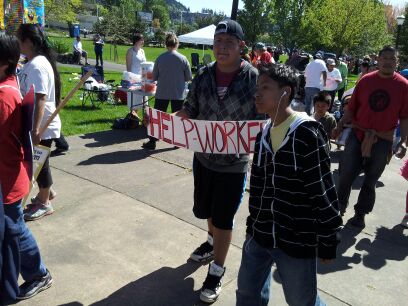
I met fellow-traveler, Mike Dumovich at the Arlington Denny’s for our third trip up north in the month. The two previous trips were for out joint appearance on KSVR-FM’s labor show, “We Do the Work!” This time we were bound for Bellingham and the Farmworkers Dignity March. I had been asked to perform by Rosalinda Guillen, Executive Director of Community to Community.
The 8-mile ma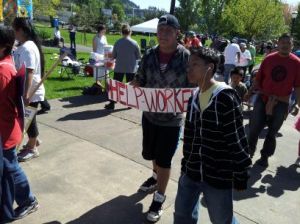 rch began 1:30 pm from an outlying community…and ended at Maritime Heritage Park in Bellingham’s downtown district. After twice getting lost, thanks in no part to my new phone’s GPS, and its inept operator, we made it in time to see the marchers arrive. They were all ages, shapes, and sizes. One old man was pushed in a wheelchair the entire route. I later learned he had lost his feet in the fields to frostbite. An array of speakers spoke to the group as an endless Mexican buffet awaited marchers and spectators alike.
One child of about 12 cried as he described how much he missed his dad who was kept out of the country due to his immigrant status. When the parent was erroneously identified as Mexican, the boy came back and stated he was, in fact, Canadian. It was a poignant moment made more poignant by the realization by many that immigration was not just a south of the border issue.
Other speakers shared stories of being courted by politicians prior to the Nov. election only to be inevitable disappointed one more time after the returns were in. Yet this time, they vowed, they weren’t going to just disappear. There was a thread of purpose…and anger…as each speaker vowed ongoing and escalated pressure…between elections. 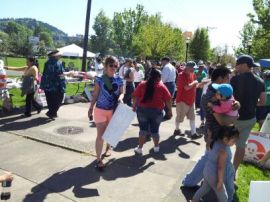
On the performance side, there was a Mexican-American entertainer named Tomas who led the crowd in traditional Spanish songs accompanying himself on a small guitar. Some high school kids in what I believe was authentic Indian attire, performe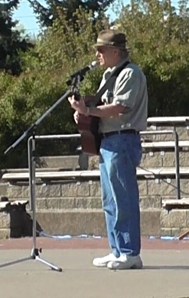 d dance and chanting.
My set was the only one in English. I felt part of something important. Something growing. This was a fight for not only dignity but life itself! The lives of families and individuals who only want what we all want. Opportunity…justice…love…
Gracias a todos!
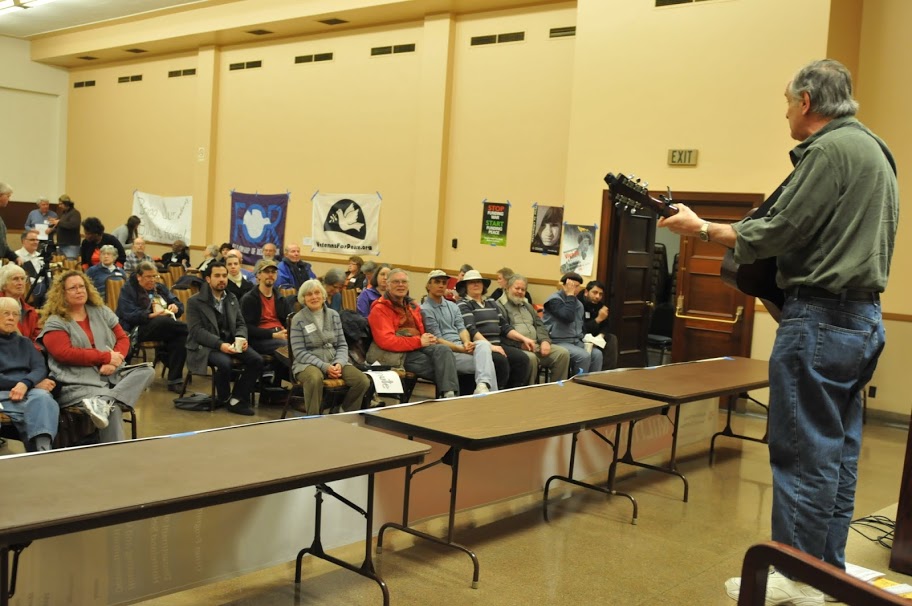
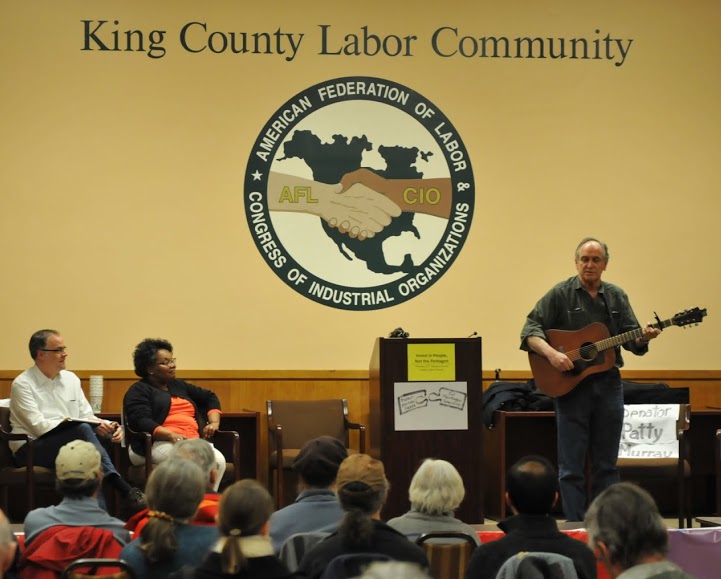
On February 22, I was honored to be asked to perform at a remarkable gathering of leaders representing the most vulnerable amongst us. Sponsoring groups included The Church Council of Greater Seattle, The Faith Action Network, American Friends Service C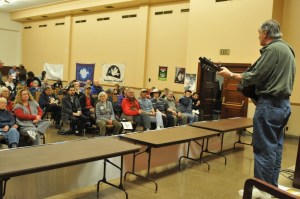 ommittee, Western Washington Fellowship of Reconciliation, GI Voice, Green Party of Washington State, Rainier Valley Neighbors for Peace and Justice, Veterans for Peace, Chapter 92, WA State Progressive Caucus, and West Seattle Neighbors for Peace and Justice.
The session came in response to a request by Sen. Patty Murray to provide stories of real people who not only need additional resources merely to survive, b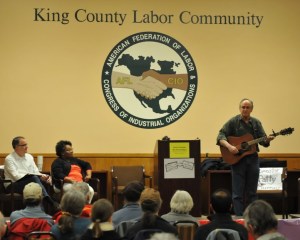 ut who will be further and dramatically put at additional risk by the looming legislative fiasco known as the sequester!
Oddly enough, neither Sens. Murray and Cantwell as well as the majority of our congressional delegation saw fit to send as much as an intern to witness the proceedings. Only Reps. McDermott and Smith dispatched staff members. As such, we were underrepresented by our representatives.
Never fear, the entire event was videoed for submission to each of their offices.
The meeting ended with a beginning; a call to immediate action: contacting our reps directly, writing letters to newspapers, and getting others to do so! And that was just the beginning of the beginning!
(Part of my contribution) http://www.youtube.com/watch?v=lwnM5FJrvQA
“A person may cause evil to others not only by his actions but by his inaction, and in either case he is justly accountable to them for the injury.” John Stuart Mill
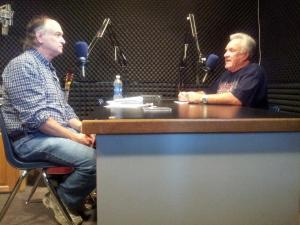
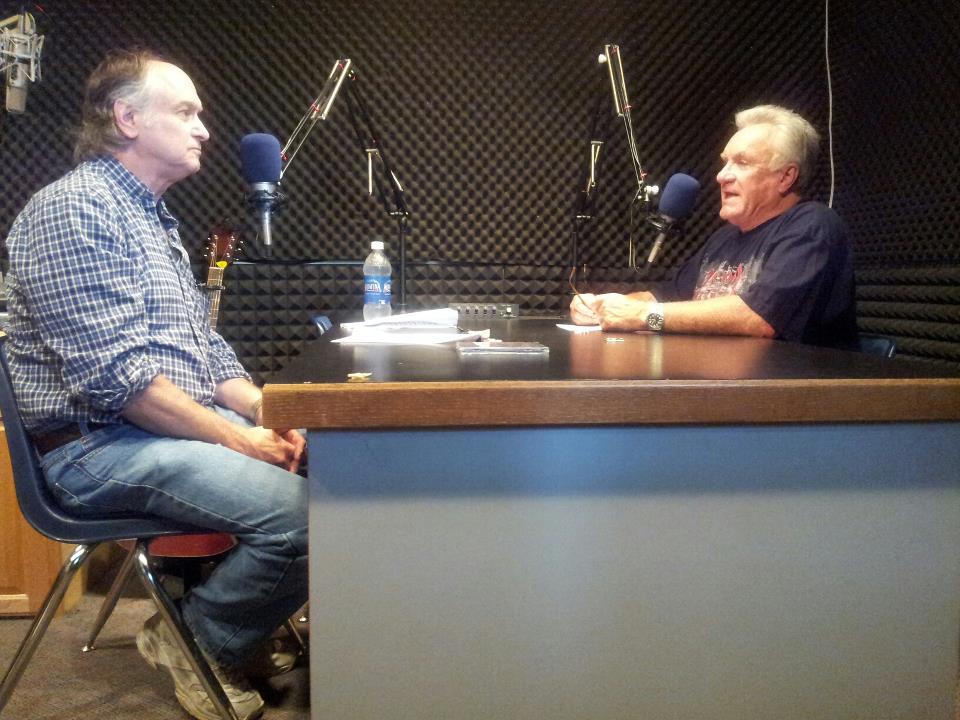
“We Do the Work” is a weekly program hosted by Rich Austin, retired ILWU member, and covering issues of concern, interest, and importance to labor. Rich invited me to chat and perform some songs…which I did. Thanks, Rich!
http://www.facebook.com/video/video.php?v=540238295992655¬if_t=video_processed
With another Seattle tribute pending to honor Phil’s legacy, this is a two-part article I wrote prior to the release of “There But For Fortune,” the remarkable film about his life. Part 2 is an interview with his equally remarkable sister, Sonny, who, at age 75, is still keeping the flame burning.

“With So Many Reasons Why…”
Recollections of a Phil Ochs Fan
Part 1
I attended my first folk music concert in the mid-sixties at Queens College in New York, where I would enroll the following year. My musical tastes at the time included a growing interest in the Beatles, a man-crush on Bob Dylan…but was still clinging to the comfortable but fading echoes of Bobby Rydell, Del Shannon, and Dion and the Belmonts.
There were four performers onstage that night. Doc Watson, Michael Cooney, Patrick Sky…and Phil Ochs. Doc Watson, now in his 80’s continues to be a mythical presence in the world of finger picking and roots Americana music. Patrick Sky and Michael Cooney remain two iconic and original figures in the world of folk music.
It was Phil Ochs, however, who changed forever how I saw, heard, and felt about music. His wit, sardonic humor, empathy, stunning images, and storytelling ability washed over me like a cultural tsunami.
I had dabbled in guitar and had pretty much mastered the same three chords I use today. I could scratch out “Blowin’ In the Wind”, “The Times They Are A Changin’”, and some of the other new instant Dylan classics. For a guy with a guitar, these tunes were obligatory…chicks dug ‘em! Oh yeah…they had a message too.
Phil also had a message…and it resonated!
The first Phil Ochs song I learned and actually sang was “Too Many Martyrs!” which tells of the murder of Mississippi civil rights leader, Medgar Evers, while referring to the earlier beating-death of 14-year-old Emmett Till. It was the first time I’d heard of either.
His name was Medgar Evers and he walked his road alone,
with Emmett Till and countless more, names we’ll never know.
“Lou Marsh” chronicled the beating-death of another young black man, not in the South but in my own city of New York. Marsh, a former Yale divinity student working as a social worker, was killed trying to head off a war between two rival street gangs in East Harlem.
Now the streets are empty, now the streets are dark
So keep an eye on shadows and never pass the park
For the city is a jungle when the law is out of sight
Death lurks in El Barrio with the orphans of the night.
These weren’t the universal anthems of the spreading civil rights/student/anti-war movement…these were headlines…about real people. These were the faces of the victims. Phil was recording moments in history…painting landscapes with stark images and colors.
Kitty Genovese was even closer to home. She was a young white woman who was attacked, raped, stabbed, and robbed outside of her home in the respectable Queens community of Kew Gardens…in the shadow of my future alma mater, Queens College. The popular version of the story is that 38 of her neighbors witnessed the event and did nothing to help her, not even calling the police. Though that number is in dispute, what isn’t is the portrait of social apathy Phil painted in “Small Circle of Friends,” citing the Genovese incident and others…with humor. Humor!
Look outside the window, there’s a woman being grabbed.
They’ve dragged her to the bushes and now she’s being stabbed.
Maybe we should call the cops and try to stop the pain.
But Monopoly is so much fun, I’d hate to blow the game.
Chorus: And I’m sure it wouldn’t interest anybody
outside of a small circle of friends.

Phil looked into the face of American foreign policy and saw it for what it was, one self-enriching military adventure after another. From our nation’s founding to the then-present (and beyond!) it was a trail of land-grabs, blood, and genocide, inevitably hidden within the empty platitudes of moral camouflage. And he was not going to participate. “I Ain’t Marching Anymore” became an anthem of a generation who questioned this rush to battle and made the conscious decision to not participate with him. People like me.
It’s always the old to lead us to the wars
Always the young to fall
Now look at all we’ve won with a saber and a gun
Tell me is it worth it all?
Those familiar with Phil’s story know that it was the 1968 Democratic Convention that brought on his disillusionment and subsequent journey into despair. The counter-culture with all its media events and truth-outs and pot and free love…etc. had really changed little in the country. Yes, the war had finally ended…as did Nixon’s presidency, but, in the grand scheme of things, the system that had created a Vietnam and a Nixon was still in place, largely intact.
Phil Ochs was not a martyr. Like the rest of us, no more or less, he was a human being, which meant he was flawed. He was a young man with a remarkable gift that brought him notoriety but not commercial success. He had no top 10 songs. Even after he had pretty much abandoned the in-your-face protest content for the lovely melodies, musicality, and images of “Flower Lady” and “Pleasures of the Harbor”, mainstream success was not to be. The audience for folk music was changing, opting for the folk/rock/country blends of bands such as the Byrds, Buffalo Springfield, Poco, The Grateful Dead, and The Band. There was also that little quartet from Liverpool and their countless progeny.
The war was over; Nixon, Agnew, and the draft were gone. Good Ol’ Jerry Ford was president. The country was exhausted from the rigors of the previous decade. It was time to kick back and party.
Phil Ochs wasn’t doing as well. He too was exhausted. Heavy drinking had exacerbated a burgeoning bipolar condition. Isolated from most of his friends, he went to stay with his sister, Sonny, in the Rockaway section of Queens.
On April 9, 1976, he hanged himself in her bathroom.
End Part One
Originally published Victory Review Magazine, 3/11 (http://www.victorymusic.us/index.php?option=com_content&view=article&id=1119:with-so-many-reasons-why&catid=140:2011-march-review&Itemid=43)
Part Two
With So Many Reasons Why…
An Interview with Sonny Ochs
On April 9, 1976, folksinger and political activist Phil Ochs ended his long bout with bipolar disorder (manic depression) by hanging himself. At the time, he was staying at the home of his sister, Sonia “Sonny” Ochs, in the Far Rockaway section of Queens, NY. Phil was 35 years old.
In the more than three decades that have since elapsed, Sonny has worked hard to keep Phil’s legacy alive through coordinating Phil Ochs Song Nights and other events throughout the US and Canada. She is very forthcoming about her brother. She spoke with me on the phone for about an hour from her home in Middleburgh, NY.
VR: What was Phil like as a child?
SO: He was rather shy and introverted. He had trouble making friends. Our father was a doctor, but due to his own manic depression he could not keep a job, so we moved a lot. [1] Phil was born in El Paso. We then moved to New York and finally to Ohio where our father got a job at a TB clinic. This made it harder on Phil; as soon as he would make a friend, we would move again.
He loved movies and would spend a lot of his time escaping into action films. He idolized John Wayne and Audie Murphy.
VR: Was your family politically active?
SO: No, we were apolitical.
VR: When did he become interested in music?
SO: He took up the clarinet in junior high school. He was so good that he was actually the first chair in the high school orchestra while still in junior high. When we again were going to move, the high school music teacher asked our parents if Phil could stay behind and live with his family.
VR: Outside of school did he have any music interests? Influences?
SO: At the time, Phil was also developing an interest in rock ‘n roll and country music. His favorites were Faron Young, Webb Pierce and Hank Williams.
VR: Did he show any interest in writing?
SO: He didn’t write songs. He wrote fiction in high school.
VR: Hard as it is to believe, Phil attended military school. Whose idea was it?
SO: It was his idea. He saw an ad for the Staunton Military Academy in Virginia on the back of a New York Times Magazine. I think he wanted to play clarinet in the band there. By the way, John Dean from Watergate fame and Barry Goldwater’s son, Michael, were also there at the time.
VR: He left after a couple of years and enrolled in Ohio State University. How did things change for him there?
SO: By an incredible coincidence, or act of fate, his college roommate was a young man named Jim Glover. Jim’s father, a Socialist, taught Phil politics. Jim introduced Phil to folk music: Pete Seeger, the Weavers, Woody Guthrie. Jim also taught Phil his first guitar chords. They formed a folk duo, The Singing Socialists, which they later changed to The Sundowners, but it didn’t last too long.
Phil was a journalism major. His left-leaning articles were too controversial for the school paper. In those days all male students were required to enroll in Reserve Officers Training Corps or ROTC (or Rot-C in many students’ lexicon of the day—author). So he started his own paper, which printed articles in favor of Fidel Castro among other things.
Jim Glover dropped out of OSU and headed for Greenwich Village to join the folk scene. There he met Jean Ray and they formed the duo, Jim & Jean. They also moved in together and were subsequently married.
It wasn’t long before Phil also dropped out of OSU and joined them. He lived in their apartment, writing endlessly. He also started gaining a reputation as a promising new talent. He hung around with folks like Bob Dylan, Eric Anderson, David Blue, and Dave Van Ronk. He also met and moved in with Alice Skinner, his future wife and mother of their daughter, Meeghan.
He was delighted when he got a regular paying gig. The owner of the Third Side Club guaranteed him a minimum of $20 per night to play there. That was pretty big money for a folksinger in those days.
VR: Which of Phil’s songs from that era were your personal favorites?
SO: “Talking Cuban (Missile) Crisis,” “Lou Marsh,” and”Power and the Glory.”
VR: Rumor has it that Phil was insulted when Dylan famously accused him of not being “a folksinger but a journalist.” True?
SO:I don’t think so. He was a journalist. He captured historical moments. Look at”Cuban Missile Crisis” and”Lou Marsh” …and “Too Many Martyrs,” which was about the murder of Medgar Evers.
VR: And your favorites among the later songs?
SO: “Pleasures of the Harbor” and “The Party.” The observations and descriptions of the “guests” were just so perfect: “The Wallflower is waiting, she hides behind composure…she’d love to dance but prays that no one asks her…”
VR: I used to do “The Party” during restaurant and bar gigs because it had so many verses and was a great time killer.
SO: (Laughter)
VR: Phil’s role as a leader and spokesperson for the activism of the ’60s is well-documented by those who were there. Yet he isn’t as well-known by the general public. Do you think the new documentary, “Phil Ochs: There But For Fortune” will help change that?
SO: I hope so. He has largely been written out of history, though he really was the voice of the anti-war movement.
VR: The film is also very honest about his mental issues…as well as your father’s similar battle with manic depression (now called bipolar disorder).[1] What were the major events that triggered Phil’s “lows?”
SO:The death of President Kennedy hit him very hard. So did those of Bobby [Kennedy] and Martin Luther King.
VR: But from all accounts, it seems like the 1968 Democratic Convention in Chicago was a real turning point for him?
SO: It was the end, really. But it got worse. He was attacked and choked into unconsciousness in Africa. His vocal cords were damaged and he lost some of his voice range.
VR: And Chile?
SO: Yes. He was a great admirer of Salvador Allende. When he visited Chile he met and became friends with Victor Jara, Chile’s hugely popular folksinger. Well, after the coup, when Phil learned that Allende had been killed and that Jara had been tortured and killed, it was awful.
He did organize a public concert, “An Evening With Salvadore Allende,” to raise funds for the Chilean people and awareness as to the CIA’s role in fomenting the coup. It wasn’t selling many tickets until Dylan agreed to attend and it sold out immediately. It was the first public statement that linked the U.S. to the coup.
VR: He was drinking pretty heavily by then. Apparently even the end of Nixon’s presidency and the war were not enough to bring him out of it.
SO: He was sleeping on the street. People didn’t recognize him.
VR: Didn’t recognize him?
SO: He had gained a lot of weight. He was sloppy, disheveled. He finally called me and asked if he could stay with me and the kids at my house in Rockaway. So, he moved in.
VR: Was he drinking?
SO: Not when he was with me. I don’t drink and he never went out.
VR: Who among his friends, if any, were there for him?
SO: Jerry Rubin was the kindest and most concerned. He knew of a doctor in California and offered to personally take Phil out to see him. But Phil refused. Then it was over.
VR: What do you think of the resurgence of interest in your brother? Do you feel he’s at long last getting the recognition he deserved…and seemed to want so much?
SO: Yes, I am glad people are discovering him and appreciating his work.
VR: What is your advice to young folksingers who are discovering Phil and would like to emulate his work?
SO: Read the newspaper!
End Part 2
Final Note
I had the privilege of being part of a group of performers who were invited to share some of Phil’s songs following the first evening’s showing of “Phil Ochs: There But For Fortune” at the Northwest Film Forum in Seattle. The movie brought back a lot of the emotion, disappointment and heartbreak of the era. Phil’s life (and death!) was a microcosm of the time. The two songs I selected were “Lou Marsh” and “The Party,” two of the songs Sonny had cited as being among her favorites of her brother’s early works.
I emailed her the following day to share the experience and the emotion of the evening. I mentioned that as a native New Yorker, I was familiar with many of the locations that were depicted in the film. One in particular was Rockaway Beach, where the family lived when they were young and where Sonny was living at the time of Phil’s suicide. I told her that my family used to go to that beach when we were young and scarf down delicacies from a boardwalk eatery called “Jerry’s Knishes.” She immediately wrote back that she too remembered Jerry’s Knishes and the recollection had made her smile. That made me smile, too. (GK)
[1] Joseph Ochs was drafted into the US Army toward the end of WWII where he treated soldiers wounded in the bloody Battle of the Bulge. Shortly after his discharge, he was institutionalized.
Originally posted in Victory Review Magazine 4/12 (http://www.victorymusic.org/index.php?option=com_content&view=article&id=1145:with-so-many-reasons-why-part-2&catid=141&Itemid=43)
I was thinking about the military-industrial-oil-communications complex, as I am wont to do, and, of course, it made me think of all the wars, conflicts, interdictions, interventions, and liberations we have inflicted on the world over the past century. I found myself humming “I Didn’t Raise My BoyTo Be A Soldier” by the Peerless Quintet (1915), which in turn, made me recall the article I was writing when I discovered it.
The article presented songs of war that had a great impact on me in how I view the practice. I also asked the readers to offer their own examples, which were presented at the article’s conclusion.
So, now, it’s time to revisit the article and see who comes up with new entries. No prizes will be awarded.
Originally posted in Victory Review Magazine (www.victorymusic.org.) December 2009

Songs that define war for me…
I was playing John McCutcheon’s classic, “Christmas in the Trenches,” an account of the legendary moment in WWI when British, French, and German soldiers laid down their arms and celebrated Christmas together. I was trying to decide if it was my favorite song about war or Christmas. Christmas won. The war angle started out as a four-way tie.
“Christmas in the Trenches,” was based on a true story. Separated from the enemy by only yards of bare terrain called no man’s land, German soldiers began setting little Christmas trees in the mud above their trenches. Then they began singing Christmas songs. Some held up hand-lettered signs in broken English requesting “no fight.” It wasn’t long before both sides, slowly at first, climbed out of their muddy holes and as McCutcheon describes:
 “Then one by one from either side
We entered no man’s land
With neither sword nor bayonet
We met there hand to hand
We shared some secret brandy
And we wished each other well
And in a flare-lit soccer game
We gave ‘em hell!
This fraternization was condemned by the brass of both sides, for obvious reasons. They correctly surmised that once enemies came to know each other as people, their effectiveness as killing machines would be compromised. In fact, for days following the truce, when ordered to shoot at each other under the penalty of court martial, many of the participants fired their rounds well over the heads of the “enemy.” Sadly, this was the first and only truce of its kind during that entire conflict.
Phil Ochs’s “I Ain’t Marchin’ Anymore” was an anthem that prompted me and many of my peers to respond to our consciences about Vietnam and the draft. It was a challenge. It was not merely a condemnation of war but a call to action…or inaction. The verses recall the bloody battles and wars, internal and external that have defined our history, tied together with a sobering statement and question:
“It’s always the old who lead us to the war
Always the young to die
Now look at all we’ve won
With a saber and a gun
Tell me is it worth it all?”
Think of Dick Cheney, Donald Rumsfeld, and Robert McNamara calling the shots…and who has consistently benefited sufficiently to determine it was “worth it all”? The soldiers? Their families?
I got out of the draft. Nobody got out of the war. Not those who fought or those who fought against it.
Ironically, there was no mention of Vietnam in the song. When Phil died, many of his fans realized that he had left us an unfinished masterpiece. I know I wasn’t the only one to add verses that included Vietnam and the Middle East debacles. Perhaps that’s the song’s greatest legacy, the sense of universal ownership, the eternal message, and the sad realization that it never will be finished.
World War I, “The war that was bound to end all wars,”has been pretty much relegated to the backseat of history. Its once noble status (Anyone remember Armistice Day?) now seems to have become “World War II: The Prolog” or “The Hobbit” to “Lord of the Rings.” So it is surprising that three of my favorite four war songs refer to that particular conflict. We have already mentioned McCutcheon’s “Christmas in the Trenches.” The other two were the works of a single person.
I was dozing on my sofa one evening a few years ago, listening to the Three Irish Tenors’ Ellis Island Concert.  Ronan Tynan’s solo was the story of a contemporary tourist, resting beside the grave of a fallen WWI British soldier, one among thousands in a military cemetery in France. He tries to flesh out who this guy was. Midway through his journey, I found myself actually leaking tears.
“And I see by your gravestone you were only 19
When you joined the glorious fallen in 1916,
Well, I hope you died well and I hope you died clean
Or, Willie McBride, was it slow and obscene?”
He wonders if Willie left someone behind who would eternally remember him as a 19-year-old? Or was he forgotten, merely an unidentified stranger in yellowing photograph inside an old family album? Did he really believe that his martyrdom would end war? Because, as he laments to the dead soldier, “it all happened again, and again, and again, and again, and again.”
Each verse is followed by the haunting chorus:
“Did they bang the drum slowly, did the play the pipes lowly?
Did the rifles fir o’er you as they lowered you down?
Did the bugles sound The Last Post in chorus?
Did the pipes play the Flowers of the Forest?”
I eventually learned the title of the song was “The Green Fields of France[1]” by Eric Bogle, a transplanted Scotsman living in Australia, writing and performing some of the best folk music in the world (www.ericbogle.com).
The other Bogle song on my list was one I had heard decades ago by the eclectic, to say the least, Irish-British folk-punk group, “The Pogues.” I had also heard a Joan Baez cover. “The Band Played Waltzing Matilda” is the story of a young free-spirited wanderer who gets drafted into the Australian army and sent to fight in the historically calamitous campaign against the Turks at Gallipoli in 1915. His ship is launched amid loud and enthusiastic “flag-waving and cheers.” Each verse is a chapter of his story that heads relentlessly from the exuberant patriotism that launches each war…to the inevitable destruction and disillusion that inevitably overtakes it.
“How well I remember that terrible day,
When our blood hit the sand and the water
And how in that hell that they call Suvla Bay
We were butchered like lambs at the slaughter.
The title of the song, also begins each chorus, and describes the results of the previous verse:
“(And) the Band Played Waltzing Matilda
As we stopped to bury our slain
We buried ours…the Turks buried theirs
And it started all over again.”
Bogle’s soldier falls victim to a shellfire, wakes up in a hospital bed to learn his legs have been amputated, and is returned to Australia with his fellow casualties “the legless, the armless, the blind, the insane” where there is no flag-waving and cheers. Instead, the few who are there to witness the casualties carried down the gangway can only “turn all their faces away.”
Did I say four songs? Writing about the physical and emotional damage suffered by Bogle’s Australian soldier, made me think of another broken veteran, this one from the Vietnam War, John Prine’s break-through “Sam Stone”.
“Sam Stone, came home,
To his wife and family,
After serving in the conflict overseas.
And the time that he served,
Had shattered all his nerves
And left a little shrapnel in his knee”
Of course the pain was best treated by the inevitable morphine drip which escalated into full-blown addiction as described in the chilling refrain: “There’s a hole in daddy’s arm where all the money goes….” Sam’s ultimate fate and that of his family is better related by Mr. Prine than me. It was a song that broke my heart and forever placed John Prine among my pantheon of songwriting gods.
Did I say five songs?
Anyone ever hear of the Peerless Quintet? Neither had I until I stumbled on an original gramophone recording of their 1915 hit, “I Didn’t Raise My Boy to Be a Soldier.”[2]. While all the previous songs were reflections back on the various struggles, this was actually a pre-emptive strike against America’s participation in WWI. At that particularly time in our history, isolationism was the overwhelming sentiment in our country and the song’s immediate and immense popularity reflected it.
The chorus says it all. It is told in the person of a woman, a mother, nailing the real meaning of war… not glory, heroics, or brass bands…but sons killing sons.
“I didn’t raise my boy to be a soldier,
I brought him up to be my pride and joy,
Who dares to put a musket on his shoulder,
To shoot some other mother’s darling boy?
Let nations arbitrate their future troubles,
It’s time to lay the sword and gun away,
There’d be no war today,
If mothers all would say,
I didn’t raise my boy to be a soldier.”
To hear the original, undigitalized recording, scratches and all, visit : http://www.archive.org/details/Peerless_Quartet_I_Didnt_Raise_My_Boy_To_Be_A_Soldier_78RPM_Dec._1914
So, what does this collection of poetry, music, imagery, and emotion add up to? When you eliminate the the slogans, jingoism, yellow journalism, FOX Newsism, and all the other hyperbole glorifying armed conflict…this means war!
Epilog
Did I say six songs? There are countless others that I could have included such as “Where Have all the Flowers Gone?”, “ Waist Deep in the Big Muddy,” and “If I Had a Hammer” (Pete Seeger), “The Willing Conscript” (Tom Paxton), “Draft Dodger Rag”, “White Boots Marching in a Yellow Land”, “I Declare the War is Over”, and “Is There Anybody Here?” (Phil Ochs), “My Uncle” (Flying Burrito Brothers), ad infinitum … but which songs moved our Victory music family and friends to confront war? Here’s what folks sent in: (the full lyrics can be found at the linked websites.)
Volkert Volkersz: “The Universal Soldier” by Buffy Sainte-Marie (made famous by Donovan) and “I Feel-Like-I’m-Fixin’-To-Die Rag,” by Country Joe McDonald (and the Fish).
Colleen Conroy: “With God on Our Side” by Bob Dylan and the Irish version of “Johnny I Hardly Knew Ye.”
Steve Peterson: “Heaven Help Us All” by Ronald Miller as performed by Joan Baez.
Thaddeus Spae: “The Story of Isaac” by Leonard Cohen.
Michael Fleckenstein: “With God On Our Side” by Bob Dylan as recorded by Joan Baez.
Mike Buchman: “Masters of War” by Bob Dylan and “Eve of Destruction” by Barry McGuire.
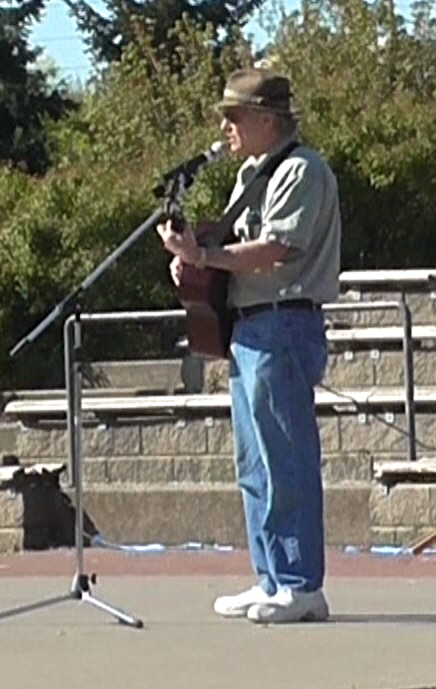
Gary Kanter is a writer and songwriter who performed at his first Open Mic in Manhattan in the early 70’s, receiving just enough encouragement to inflict his songs and humor on audiences in the Canadian Maritimes, Nashville, and the Pacific Northwest. He has recorded two CD’s “Gary Kanter’s Senior Moment Comeback Tour (Live)” and “Good-Bye, Dr. Laura!”
[1] Some versions of this song are titled “No Man’s Land.”
[2] Lyricist: Alfred Bryan; Composer: Al Piantadosi
This past week I was invited to sing at three community action events.

My competence and confidence in my messaging and musicianship came of age following the protests of the 60’s-70’s. That shift was more than adequately staffed by the likes of Bob Dylan, Tom Paxton, Dave Van Ronk, and my personal muse, Phil Ochs.
While I did learn many of their songs…and played them on the road and in various communities in which I lived, it wasn’t part of the movement. It was music sharing with like-minded folks. The war was over and until we could find other distractions, it was our comfort food. It reminded us we were still not marching anymore and veterans of the movement.
When I did begin performing my own music, it was for entertainment value. I salted the repertoire with some of the mellow songs of the 60’s writers along with the requisite Woody Guthrie material, but that was, again, to affirm my street creds as a 60’s guy…with 60’s values. I was carrying on the tradition of my heroes.
During my extended hiatus during the 80’s, 90’s, and beyond, I occasionally dabbled in writing topical songs…which were usually sung and disposed of as is the fate of such compositions. As some of them were actually …good…not bad…I found myself becoming more immersed in the genre.
When I finally did my first open mic in decades, the song I performed was “Rush is a Four-Letter Word.” It was well-received. When I attended my first Ancient Victorys at Tacoma’s Antique Sandwich Company, I did “Rush” along with “I Wish Woody Guthrie Were Here Today.” They established me as a humorist and topical folkie in this world of excellent eclectic and acoustic music. It was a label I was not entirely uncomfortable with. It reaffirmed my dormant 60’s sensibilities…with an added bonus. When I followed one of these tunes with something serious and mournful, it added a remarkable juxtaposition that the audience was not prepared for. I still like to do that.

Fellow corporatesexual, Angela Vogel-Person-Inc.- Ltd.-LLC assisting me in singing “I’m Gonna Marry G.E.”
But it was still for entertainment purposes…audience acceptance. As were my two cd’s. It was only later when I followed my instincts and began organizing benefits for various progressive causes and disaster relief, that I realized entertainment was only the means to the end. My music, like that of my predecessors, needed to be part of something more. It had to be transformational. So the events became more political and high profile, culminating in last week’s Occupy events. It felt like home.
The news of the Wisconsin recall elections was just one more kick in the stomach for a week filled with them here in Seattle.
We were rocked by a shooting rampage by a deranged individual that ended the lives of members of our music community as well as his own. Lymphoma took the just-turned 18-year-old daughter of the owner of one of our favorite music and performing arts venues, cafes, and bookstores.
Those of us who didn’t know the victims know people who knew them, were close to them. It is their grief that makes us grieve with them…for them. It is the living we go on with, comforting, consoling, trying to make sense out of the incomprehensible, find order in randomness, and perhaps just crying.
Wisconsin can be seen as an allegory to what we have been experiencing here…playing like a Greek tragedy. For over a year we have witnessed the slow…inevitable…painful death of Wisconsin’s democracy as it suffered the disease of corporate personhood in the form of an endless cash infusion. We saw the wave of destruction as Walker and his masters continued to wreak havoc on the working people of Wisconsin. Then we saw the self-inflicted wound administered by those who voted against the recall. These people only vote against and never for anything. The result is a state with nearly 6 million victims…an infamous number in citing victimhood.
No, I am not comparing Scott Walker and his owners to Adolf Hitler. Hitler was a megalomaniac who, though mad, was sincere in his evil. Scott Walker is a bagman.
A more odious comparison is Joseph Goebbels and Karl Rove. Just as Rove learned his craft from his mentor, the late Lee Atwater (of the infamous and blatantly racist “Willie Horton” ad), he has channeled Goebbels. If the true history of this era survives to be told, Rove will share Goebbels’s dubious reputation for sowing the seeds of hatred, bigotry, and fear among his people that spawned the end of democracy. We forget, Hitler was duly elected by the German people.
If there were truly a just creator, Goebbels and Rove would have an eternity to congratulate each other on the success of their brilliant messaging, while mulling over the consequences…not in snowy Wisconsin or rainy Seattle… but a much warmer place.
Arlo: The Son Also Rises
(In Search of my Inner Guthrie)
I began the telephone interview, as is my policy, with full disclosure. I advised Arlo not to expect objective journalism. I told him that I was a fan of his since a friend thrust a copy of the newly-released Alice’s Restaurant record into my hands in 1967 while sitting in a classroom at Queens College. “Holy crap!” I uttered, “That’s Woody Guthrie’s son!”
That was 45 years ago.
Like most of my peers in the worldwide web of folk music, I have always considered Arlo my brother. After all, aren’t we all “Woody’s children?”
But there were other connections, mostly geographic…
For instance, I grew up in Queens Village , NY, which was also the home of Creedmoor State Hospital where Woody’s chronic battle with Huntington’s Disease reached its inevitable conclusion.
As I went merrily about my way, playing stickball and sneaking cigarettes with my friends, Woody was being visited by his friends such as Ramblin’ Jack Elliott and Bob Dylan.
Later in the decade, I spent my summers as a counselor at a summer camp outside of Great Barrington, MA, which is currently the home of the Guthrie Center and a stone’s throw from Stockbridge and Alice’s Restaurant.
Another intersection of our lives was Fort Hamilton where we both dealt with our own selective service comedies. Arlo told me that though he had started the process at the now-iconic Whitehall Street, he finished up at Fort Hamilton on the southern tip of Brooklyn. My disqualification was not the product of a misdemeanor littering charge but rather the recommendations of shrinks from NYC and SF attesting to the fact that the army would be a better place without my presence.
Finally, to celebrate my new-found status as unfit for military service, I jumped on the subway and rode it a few stops to Coney Island where I transferred to the Cyclone, the then-tallest roller coaster in the world where I spent the remainder of the afternoon. Coney Island, of course, was the home of the Guthrie Family during Arlo’s childhood.
There is one other connection that I had not known. We both hade maternal grandmothers named Greenblatt. Go figure!
Oh yeah, trying to emulate his dad, I rode a freight car through British Columbia. Almost froze my lower extremities. Thanks a lot, Woody!
I contacted Arlo at his motel in Irving, TX, on Sunday Morning at 10:00 am, central time. He had recently risen and had yet to have his breakfast.
VR: I was at the Zoo tunes show you did a few years back in Seattle with your kids. When you were introduced Coming Into Los Angeles, you talked about having recently encountered some Secret Service agents at an airport. They had recognized you and were walking your way. As you described, you wondered what they wanted as “I had not become the threat I’d hoped to be….” Then upon arriving at your seat, one smiled and said, “Guthrie, are you coming into Los Angeles, bringing in a couple of keys?” Great story. Great laugh.
What did you mean by the statement “I had not become the threat I’d hoped to be…?”
ARLO: When you’re 19-20 years-old, the world doesn’t change fast enough. But as you grow older you sort of evolve into an elder statesman. I learned that working and touring with Pete Seeger. We didn’t start out traveling together…we just began showing up at the same places, after awhile, we began scheduling limited annual tours for 30 years. Now that Pete is older, I’ve been doing some myself…the elder statesman.
VR: One of the first things I saw when I opened my Facebook page today was a blurb for your upcoming April 14 show at the Pantages Theater in Tacoma. It began, “Arlo, son of famed folksinger, Woody Guthrie…”
It’s been 45 years since Alice’s Restaurant. Do you think that ongoing reference to your dad has overshadowed your own identity as an artist?
ARLO: Don’t care. I don’t write those blurbs. They’re written by PR folks. Besides I’m proud to be billed in that manner. It’s a continuity. Recently, I was in Sweden, playing some of the smaller clubs I don’t get a chance to do here these days. I went into one for the first time and the first thing I saw was a concert poster of Sarah Lee and Johnny (Arlo’s daughter, Sarah Lee Guthrie and husband Johnny Irion). So, there I was…Sarah Lee Guthrie’s father!
VR: Your family has been called….
ARLO: Don’t use the term folk royalty…
VR: I was going to say the first family of folk music. At least the most celebrated. You grew up among the most celebrated members of the folk music community. Of those, who were your greatest influences…teachers…?
ARLO: Brownie McGee and Sonny Terry were like my uncles. My mother always took me to see them wherever they were performing. Brownie on guitar, Sonny on harp. Doug Dillard…banjo. I stole from everybody.
VR: Your dad would call that…research.
ARLO: I researched from everybody. I would go to see Mississippi John Hurt, sit in the front row and just watch his hands. The Everly Brothers…Cisco Houston. I actually did my first performance at Gerdes Folk City in NY with Cisco. I was 13. It wasn’t planned. He called me up on stage. It was his last performance. He died of cancer a few months later.
VR: That’s continuity. I want to talk a bit about your dad.
ARLO: Did you know he had a photographic memory?
VR: No.
ARLO: He also read everything. I remember talking to the librarian of the public library in one town who told me he had read every book on their shelves. And he remembered everything he read.
VR: And wrote about a lot of it. What do you think were his most important songs…and your favorites? Starting with “This Land Is Your Land.”
ARLO: That’s not what I consider among his best. Actually songs like “1913 Massacre,” “Sacco & Venzetti,” and “Tom Joad” were among the most important and best. My dad wrote “Tom Joad” after seeing “Grapes of Wrath.” When John Steinbeck heard the recording he sent Woody a brief letter which read: “”You little bastard. You said in twelve verses what it took me an entire book to say.”
VR: Coming back to “This Land Is Your Land” and the other sing-alongs. Doesn’t that go back to the continuity thing? It connects us to Woody and to each other. “This Land” has also been called the people’s national anthem.
ARLO: True
(At this point, Arlo reminded me he had not as yet had his breakfast; I reminded him that I would be reviewing his 4/14 show at the Pantages)
VR: One more thing and I’ll let you eat. Your kids are all out there performing and now your grandkids. Did you encourage them?
ARLO: I discouraged them. Or tried to. I told them that if you are going to do this, it’s got to be everything that you do. You cannot do anything else. You will be burning bridges. Plus, you have to find the people who you want to learn from and be with them. Make yourself useful…take out their garbage…wash their cars. There’s no substitute.
VR: What was the most important thing you learned from your parents?
ARLO: Be yourself. It’s better to have failed as yourself than failed trying to be someone else.
VR: Bon Appetite.
……………………………………………………………………………………………………………
Gary Kanter is a writer and songwriter who performed at his first Open Mic in Manhattan in the early 70’s, receiving just enough encouragement to inflict his songs and humor on audiences in the Canadian Maritimes, Nashville, and the Pacific Northwest.
Also by Gary Kanter:
Back in November, we celebrated the life of Joe Hill at the Anchor Pub in Everett. We enjoyed it so much 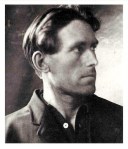 we decided to take it, in various iterations to venues around the area.
Friday night we will be bringing it to Couth Buzzard Books in Greenwood. Mike Dumovich, Dan Roberts (sans Whateverly Bros.), and I will be there from the first show, with Shannon Beck joining us to offer her interpretations of “Bread and Roses”, “I Dreamed I Saw Joe Hill Last Night,” and “Rebel Girl” with a few additional songs thrown in. Shannon is an excellent performer and talented writer in her own right.
In addition, we will be featuring Mark Hillman in the character of Joe Hill to add authenticity to “the man who never died” theme. Mark begins his narration in Joe’s native Swedish. He confessed that his accent is more that of a Finnish-Swedish accent but we assured him our audience would kindly let it go….
Gonna be a good show!
See you all there.
 t recent performance…a Songwriters in Seattle showcase at the Couth Buzzard. When I took my place to sing, she struggled to her feet from the table where we had been sitting and joined me. She lay down at my feet and heard, once again, how she had, shortly after we selected her from the pound, inspired me to write and perform songs again. My first new song was, appropriately, “Life Goes Better With a Dog!”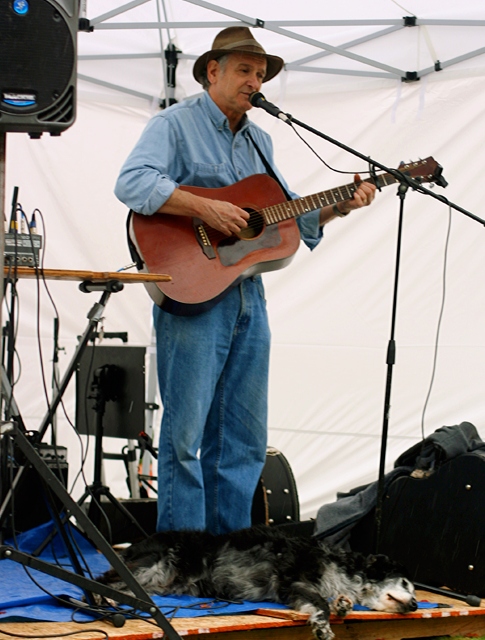



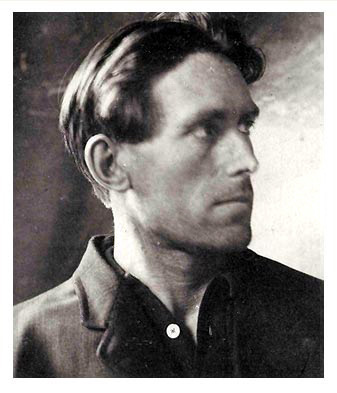
 Gary Kanter